YOUR FORMAT.
YOUR RULES.
Eleven tournament systems, supermêlée with changing teams, plus multi-day tournaments, series and club championship.
The eleven systems.
Round robin / League
Every team plays every other team once, and nobody is eliminated. Ranking is by wins, with ties broken by points difference.
For 4–10 teams
Swiss system 100–500
A fixed number of rounds; in every round, teams with the same record meet. Nobody is eliminated; ties are decided by the Buchholz score.
From 8 teams, also for large fields
Knockout
Lose and you are out, until one team is left. The first round is filled up with byes. Fast and exciting.
For 16–64 teams
Double knockout
Lose in the winners’ bracket and you play on in the losers’ bracket; you are only out after a second defeat. In the grand final, the winners of the two brackets meet.
For 8–32 teams
Poule
Groups of four played as double knockout, with winners’ match, losers’ match and barrage. The top two of each poule go through to the knockout finals.
For 16–64 teams
Formule X
The first round is drawn at random; after that, pairing is strictly by rank: 1st against 2nd, 3rd against 4th. Scoring uses win points, points scored and points difference.
For 8–32 teams
Mêlée suisse 100–500
Supermêlée by the standings: teams are formed afresh every round, by rank rather than by lot. Players who are doing equally well play each other; scoring is individual.
From 12 players
Ostbayerisch 100–200
Three Swiss preliminary rounds in which only wins count. Then the top half goes into the A tournament and the bottom half into the B tournament, both played as knockout.
From 16 teams, also for large fields
Maastricht 100–250
A Swiss preliminary stage, after which the field is split by rank into two to four sub-tournaments (A to D), each played as knockout.
From 24 teams, also for large fields
Nunkirchner
Three randomly drawn preliminary rounds, after which the field is split by rank into groups of eight (A, B, C …), each played as knockout.
From 24 teams: always six rounds, however large the field
Poule with cadrage 100–500
Like the poule, but with the three knockout fields of the big French tournaments: 1st and 2nd of each poule go into the Principal, 3rd into Consolante A, 4th into Consolante B. The cadrage brings each field to a power of two.
From 48 teams, for particularly large tournaments
Which system for large fields?
- Poule with cadrage: the format of the big French tournaments. Every team is guaranteed its poule and then a knockout field; three knockout fields run at the same time.
- Swiss system: a fixed number of rounds, nobody is eliminated. Five to seven rounds are enough even for several hundred teams.
- Ostbayerisch: up to about 200 teams. After three preliminary rounds the field splits cleanly by number of wins into the A and B tournaments. The finalists play nine rounds, ten from 129 teams upwards.
- Maastricht: up to about 250 teams. Four sub-tournaments (A to D) instead of two, which saves one round compared with Ostbayerisch: eight rounds up to 128 teams, nine up to 256.
- Mêlée suisse: for individual players who are put together into new teams every round.
If there are more matches than lanes, the draw splits every round into waves. The app shows how long the day will then take as soon as you set the tournament up.
Supermêlée: reshuffled every round.
In a supermêlée (also written supermelee or super mêlée) everyone signs up on their own. Before every round Boule-Boy puts the teams together afresh, as doubles or triples, and scores each player individually. It suits the club evening just as well as the open tournament where everyone who turns up plays.
Three kinds of supermêlée
- Random mix: the classic supermêlée. Partners and opponents are drawn at random every round.
- Mêlée suisse: by the standings rather than by lot. Players who are doing equally well play each other; on every lane the strongest and the weakest play together.
- Formule X: from the second round onwards pairings follow the standings, with Formule X scoring.
If the number of players does not divide into doubles, you decide: form one triples team, let one player play alone with six boules, or give a bye. Supermêlée is already included in the Free plan.
Boule & Bike: every round at a different venue.
In Boule & Bike every round is played at a different boules venue. In between, the group cycles on together, with a break for a meal. It is played as a supermêlée: partners and opponents change at every stop, and each player is scored individually. Boule-Boy plans the tour and guides the group through the day.
What Boule-Boy takes care of
- Timetable: every stop with arrival time, cycle route, kilometres and metres of climb; plus the weather on site at the planned time.
- Tour map and roadbook: the route on the map, as a PDF for the handlebar bag.
- “We are moving on”: an announcement in the tournament chat and on the scoreboard; the web view shows everyone the next stop with a navigation button.
- “I am here”: everyone checks in at the stop, and all can see how many have arrived.
- Special awards: winner of each stop, stage king and best comeback after the break; the winner of the last stop wears the stage jersey until the next one.
- Tour report: after the tournament a PDF with the map, photos of the stops and the standings for the club chronicle.
Boule & Bike is chosen as the tournament type when creating it. It has no single venue; its stops are the venues.
A look inside Boule-Boy.
Original screenshots from the tournament software: registration, match day, wrap-up and club organisation.
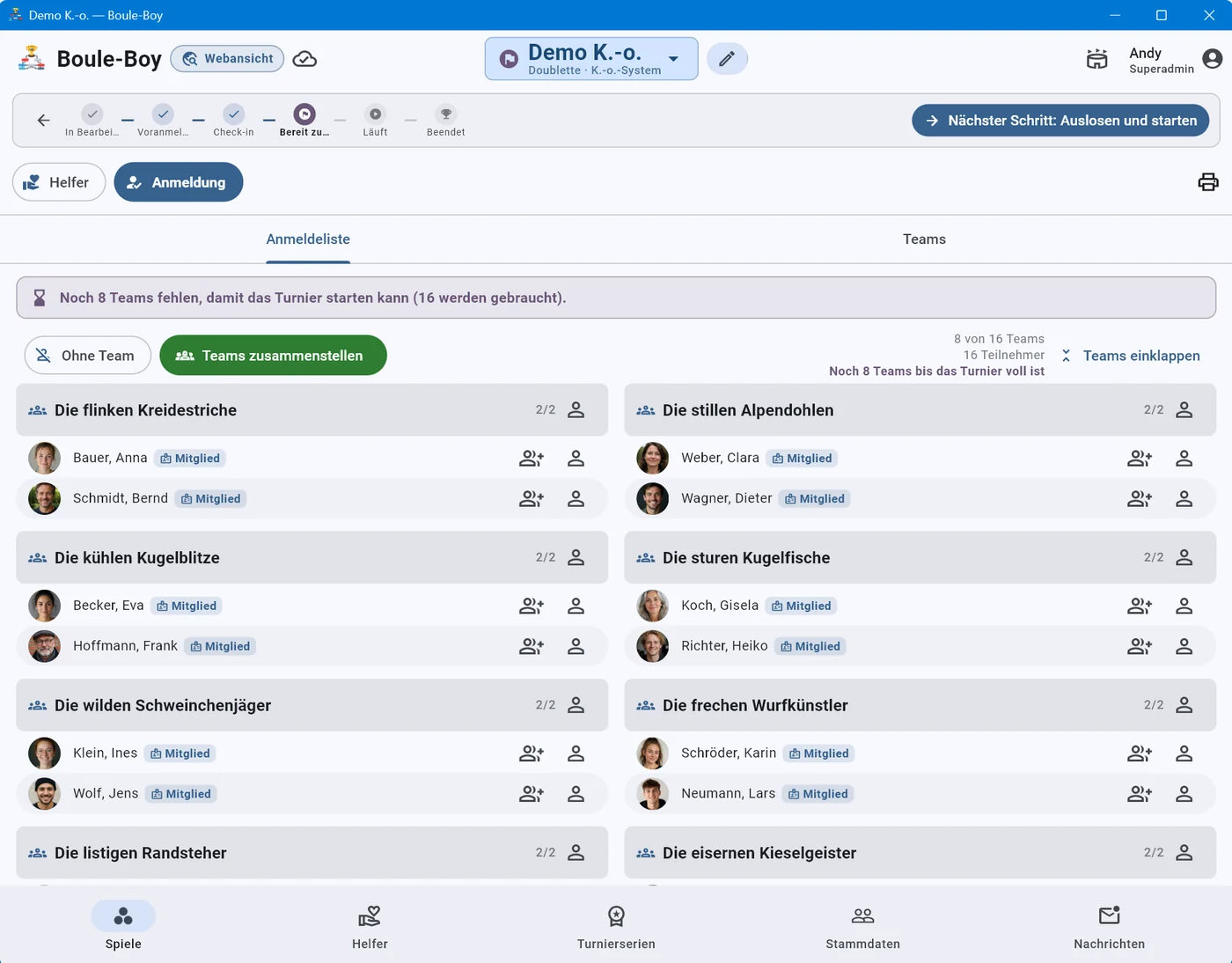
Setting up a tournament
Original view of a configured Boule-Boy tournament.
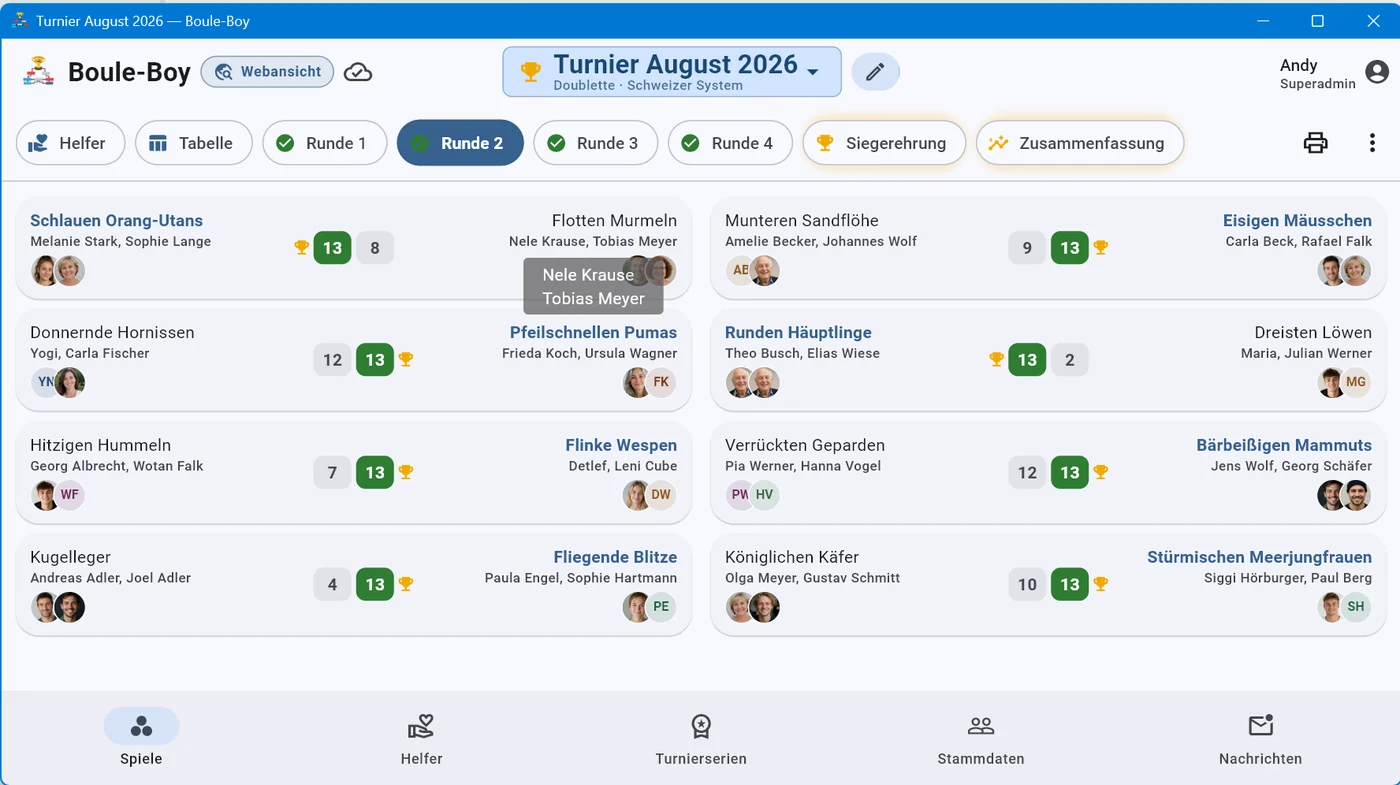
Round of play
The tournament desk while the competition is under way.
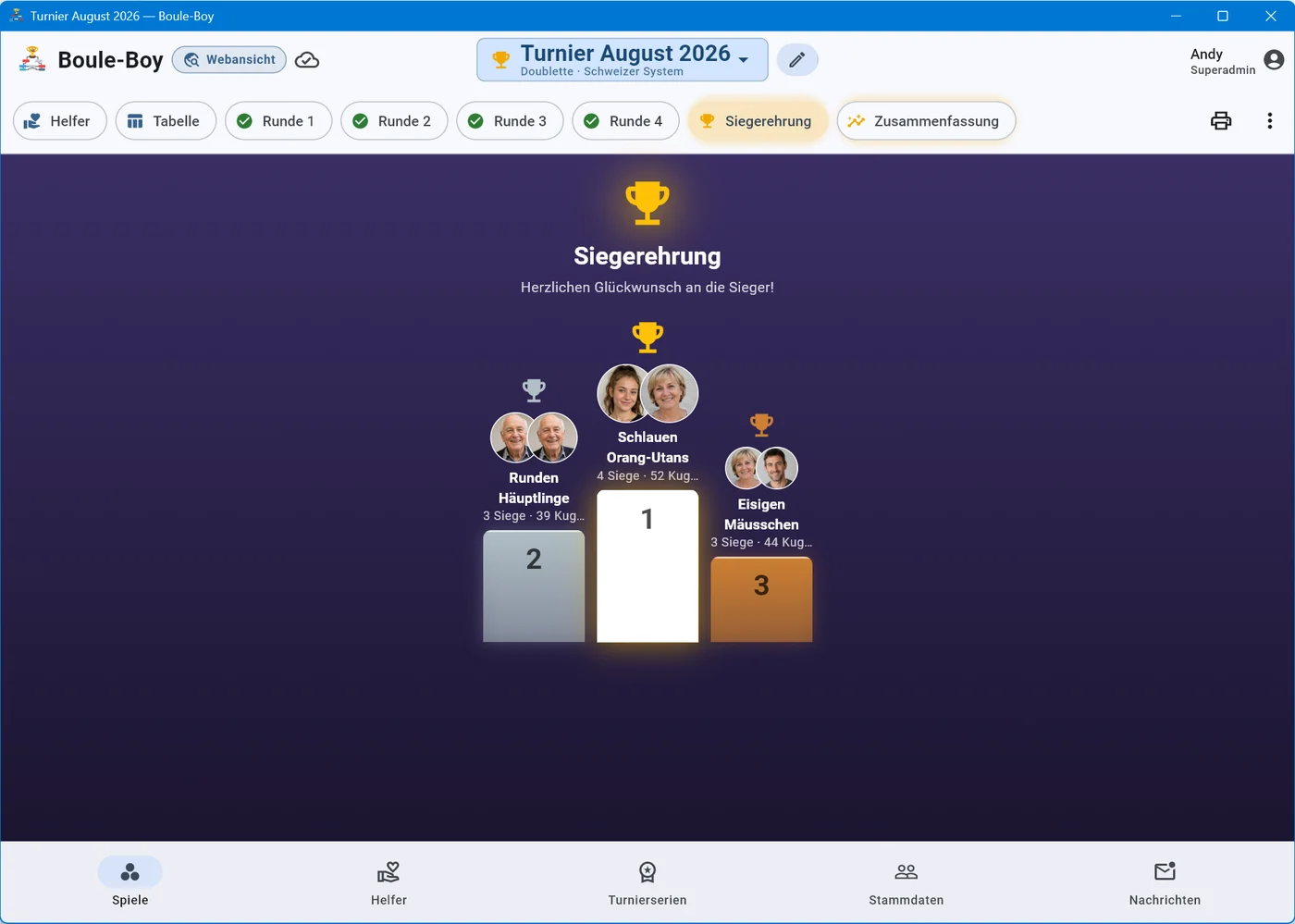
Awards ceremony & placings
The finish, with an overview of the winners.
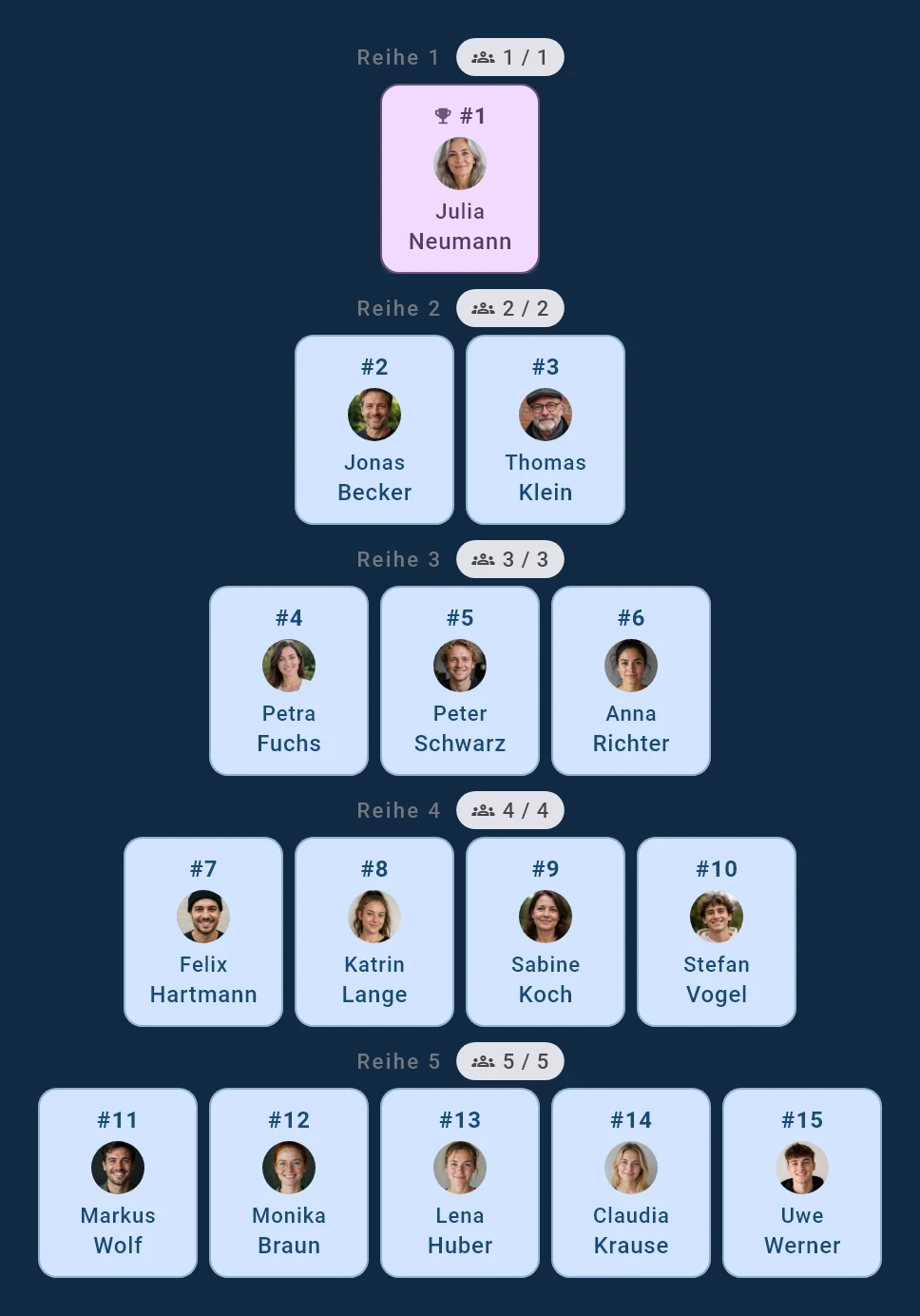
Pyramid · Club championship · Series · Boule bingo · Bag-Tag · Boule & Bike
On top of that come season and multi-day formats with their own standings and awards: club championship, row pyramid, tournament series with overall standings, Bag-Tag, Boule bingo and Boule & Bike.
The row pyramid runs all season: challenge someone one row up and win, and you swap places. Everyone sees at a glance whom they may challenge, in the app and on the scoreboard.